Frank laid out an amazing summary of what is coming from the IMF. We are headed to a single global currency. There are many others calling for this as well. As our Dollar and the Euro continue to stumble, pressure will increase to move away from them. This could accelerate with another “event”, like the crash a year ago. Listen to the video summary by Frank where he goes over this topic and the documents linked below.
“ A newly published IMF strategy document calls for the implementation of a global currency, called the “bancor”, to stabilize the international monetary system, while acknowledging that only a monumental shift toward acceptance of globalism will make it possible in the short term.
The IMF blueprint, authored by Reza Moghadam, director of the IMF’s strategy, policy and review department, has stayed under the radar for three months.
However, an article on the Financial Times blog alphaville, entitled IMF blueprint for a global currency – yes really, today highlights the document and the clear strategy of the global financial body.
“…in the eyes of the IMF at least, the best way to ensure the stability of the international monetary system (post crisis) is actually by launching a global currency.” Izabella Kaminska notes.
“And that, the IMF says, is largely because sovereigns — as they stand — cannot be trusted to redistribute surplus reserves, or battle their deficits, themselves.”
A chart within the document, innocuously titled Reserve Accumulation and International Monetary Stability (PDF link), presents a stepping stone system toward a fully fledged global currency:
Beginning with a vague recommendation for “voluntary policy adjustments” to be adopted by member states, the chart moves through more and more draconian economic policies toward a long term endgame of a global currency.
The chart also plots “potential resistance” to each stepping stone from sovereign states, with a spike in the short term, followed by a lull, and then a general rise as the move toward a global currency progresses over time.
The IMF’s road to a global currency hinges on a wider use of and eventual implementation of an international monetary system based on special drawing rights (SDR), the IMF’s synthetic paper currency.
Once an SDR-based system is in place, the IMF envisages just one final step to the launch of a new global currency.
The document even gives the global currency a name, the “bancor” after John Maynard Keynes’ proposed, but never implemented, World Currency Unit of clearing.
The following section of the IMF document highlights this:
48. From SDR to bancor. A limitation of the SDR as discussed previously is that it is not a currency. Both the SDR and SDR-denominated instruments need to be converted eventually to a national currency for most payments or interventions in foreign exchange markets, which adds to cumbersome use in transactions.
And though an SDR-based system would move away from a dominant national currency, the SDR’s value remains heavily linked to the conditions and performance of the major component countries. A more ambitious reform option would be to build on the previous ideas and develop, over time, a global currency. Called, for example, bancor in honor of Keynes, such a currency could be used as a medium of exchange—an “outside money” in contrast to the SDR which remains an “inside money”.
Below is a photo I took from the International Monetary Fund Document item # 48
Moving on, when you read the rest of the report from Alex Jones, which I checked out from the original report from the April 13, 2010 IMF document it does say what Alex wrote about, and I have some more photos from the IMF doc for you.
“The document concludes that without a catalyst to create a sudden clamour for globalism, the implementation of a global currency will take time:
It is understood that some of the ideas discussed are unlikely to materialize in the foreseeable future absent a dramatic shift in appetite for international cooperation.
The IMF first touted the possibility of a new global currency in March of last year. The issue was then debated at the G20 Summit in London just days later.
-
in Point 19 of the communiqué issued by the G20 leaders led to analysts describing the dawn of a “revolution in the global financial order.”
“We have agreed to support a general SDR allocation which will inject $250bn (£170bn) into the world economy and increase global liquidity,” The clause stated.
“In effect, the G20 leaders have activated the IMF’s power to create money and begin global ‘quantitative easing’. In doing so, they are putting a de facto world currency into play. It is outside the control of any sovereign body. Conspiracy theorists will love it.” Ambrose Evans-Pritchard of the London Telegraph wrote at the time.
“The world is a step closer to a global currency, backed by a global central bank, running monetary policy for all humanity.” he added.
The same conclusion was drawn by the Washington Post’s Anthony Faiola, who described how the IMF is on course to be transformed into “a veritable United Nations for the global economy
http://ftalphaville.ft.com/blog/2010/08/04/306346/imf-blueprint-for-a-global-currency-yes-really/
http://www.imf.org/external/np/pp/eng/2010/041310.pdf
http://www.washingtonpost.com/wp-dyn/content/article/2009/04/19/AR2009041902242.html?hpid=topnews
Below you will find more news about leaders pushing for a global currency.
Nazarbaev Circulates His Currency Vision
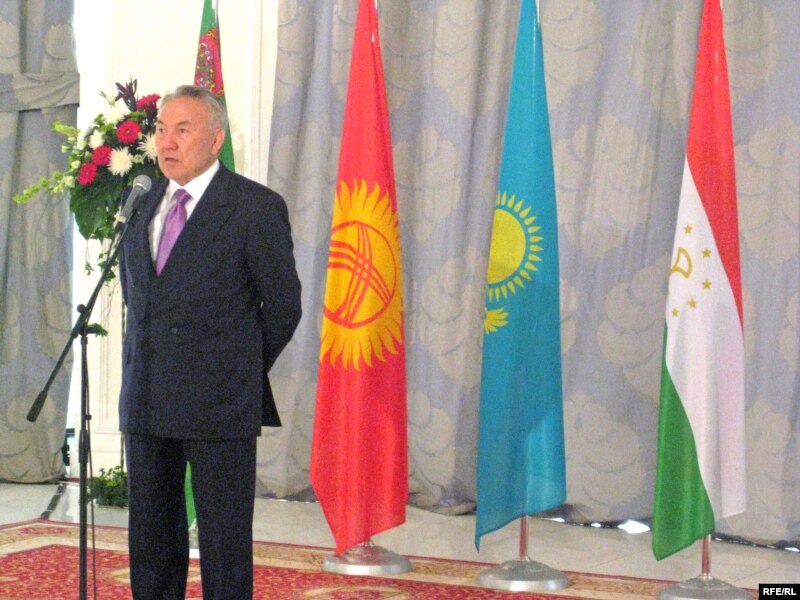 “Kazakh President Nursultan Nazarbaev has been stumping hard for the “akmetal.”
July 29, 2010
Kazakh President Nursultan Nazarbaev appears keen to introduce a common global currency. One way or another. “I continue to insist that the new global economy requires a new global currency,” Nararbaev said during a recent economic forum in the Kazakh capital, Astana. He also “continued to insist” on the topic during an informal meeting of the OSCE Foreign Ministers in Almaty earlier this month. In his article, “Keys To The Crisis,” published in the Russian newspaper “Rossiiskaya gazeta” in February 2009, Nazarbaev suggested that a common currency could help lead the world out of financial turmoil. Nazarbaev has suggested calling it the “akmetal,” a word coined from the Greek “acme” — meaning “supreme” or “best” — and “capital.” The Kazakh president says that with the akmetal firmly in place, the term “akmetalism” could eventually replace “capitalism” to describe the world’s dominant economic system. In the past, he has suggested the creation of a common currency for the Eurasian Economic Community, a regional treaty comprising six former Soviet countries — Russia, Belarus, and the Central Asian republics sans Turkmenistan. Nazarbaev is by no means the first advocate of such a scheme. In the 1940s, leading British economist John Maynard Keynes suggested the creation of a common currency along with a world central bank and an international clearing union to manage it. He wanted to call the common currency the “bancor.” Keynes’ bancor never materialized, but his idea for world financial institutions eventually led to the creation of the so-called Bretton Woods institutions: the World Bank and the International Monetary Fund. So, despite an apparent lack of supporters for the akmetal, don’t kill Nazarbaev’s idea just yet. Leave it to future economists and akmetalists to decide.”
 myBlessedHope
