I mentioned this in a post I made yesterday on something that is foreshadowing a Revelations prophecy of one of the seven seals, with the extreme difference in wages between elite and common man. This really relates to two areas, the collapse of our economy, leading to one world currency and government and the extreme out of balance that will exist during the final days.
I marvel at how anyone can think this is sustainable. The Federal employees salaries are all paid for by the private sector, and yet we have them making on average double. That means it takes many, many more people working to support the bureaucracy.
We hear that people today lack common sense, but I suggest that we all still have it, we are just to busy running to and fro to stop, listen, and think about any topic.
To quote the article (the last line): “Federal compensation has grown 36.9% since 2000 after adjusting for inflation, compared with 8.8% for private workers.”
There are dozens of headlines now showing up. The media and the world is waking up to the reality that is coming our way from the poor decisions we have made over the last ten plus years. Unfortunately most of them are the foreign media outlets. I have chosen two of them to highlight today.
The Dollar is on its way down, I have heard predictions from end of the year to sometime in 2011 for the full crash. Predictions are difficult but you need to prepare for the depression that we are waking up to as a nation. Times will be tough here in the US but also you will see a ripple effect around the world, as the second article speaks to.
One of those golden truths, “you can’t see the forest for the trees”, I believe applies here. The rest of the world sees what we are doing and they are getting out first, not wanting to go down with the ship. Those that are awake, are starting to read and watch foreign media sources because they show much more of the truth. I saw an article on that yesterday. It is time we wake up, and wake up our neighbors and extended family.
All of these events are foreshadowing the coming collapse that will lead us to One World Currency and One World Government. It has been prophesied in the Bible. So turn to God for guidance, wisdom, and discernment. He is trying to get our attention with all of this and wants us to turn back to him so that we will be saved.
There are several articles linked below that cover a decision the Federal Reserve made yesterday and the fall out from it. The Fed is looking to spur growth by buying government debt. This is also called “monetizing” our debt, which is basicly the right hand buying from the left hand. The Fed prints the money to buy our own governments debt and then charges us interest on it. Not a good situation to be in.
You may ask, “how did we get to this point?”, well it is pretty simple, we spent more than we had available and have promised more than we could possible deliver on.
I think the following four articles do a good job running down the implications of our situation. We are bankrupt.
How does this tie into prophecy? I will lead to our the colapse of our country and probably the world economy, which will allow for the rise of One World Government and One World Currency. At a minimum, I think the life of the US dollar is very short. The key is we need to prepare, get out of debt, diversify our investments, and stockpile some food and durable goods.
This will be our downfall as a nation. How did we get suckered into this scam? We will print money to support it which will lead to the downfall of the US dollar and eventually to one world government. Very Sad!
Frank laid out an amazing summary of what is coming from the IMF. We are headed to a single global currency. There are many others calling for this as well. As our Dollar and the Euro continue to stumble, pressure will increase to move away from them. This could accelerate with another “event”, like the crash a year ago. Listen to the video summary by Frank where he goes over this topic and the documents linked below.
“A newly published IMF strategy document calls for the implementation of a global currency, called the “bancor”, to stabilize the international monetary system, while acknowledging that only a monumental shift toward acceptance of globalism will make it possible in the short term.
The IMF blueprint, authored by Reza Moghadam, director of the IMF’s strategy, policy and review department, has stayed under the radar for three months.
However, an article on the Financial Times blog alphaville, entitled IMF blueprint for a global currency – yes really, today highlights the document and the clear strategy of the global financial body.
“…in the eyes of the IMF at least, the best way to ensure the stability of the international monetary system (post crisis) is actually by launching a global currency.” Izabella Kaminska notes.
“And that, the IMF says, is largely because sovereigns — as they stand — cannot be trusted to redistribute surplus reserves, or battle their deficits, themselves.”
Beginning with a vague recommendation for “voluntary policy adjustments” to be adopted by member states, the chart moves through more and more draconian economic policies toward a long term endgame of a global currency.
The chart also plots “potential resistance” to each stepping stone from sovereign states, with a spike in the short term, followed by a lull, and then a general rise as the move toward a global currency progresses over time.
The IMF’s road to a global currency hinges on a wider use of and eventual implementation of an international monetary system based on special drawing rights (SDR), the IMF’s synthetic paper currency.
Once an SDR-based system is in place, the IMF envisages just one final step to the launch of a new global currency.
The document even gives the global currency a name, the “bancor” after John Maynard Keynes’ proposed, but never implemented, World Currency Unit of clearing.
The following section of the IMF document highlights this:
48. From SDR to bancor. A limitation of the SDR as discussed previously is that it is not a currency. Both the SDR and SDR-denominated instruments need to be converted eventually to a national currency for most payments or interventions in foreign exchange markets, which adds to cumbersome use in transactions.
And though an SDR-based system would move away from a dominant national currency, the SDR’s value remains heavily linked to the conditions and performance of the major component countries. A more ambitious reform option would be to build on the previous ideas and develop, over time, a global currency. Called, for example, bancor in honor of Keynes, such a currency could be used as a medium of exchange—an “outside money” in contrast to the SDR which remains an “inside money”.
Below is a photo I took from the International Monetary Fund Document item # 48
Moving on, when you read the rest of the report from Alex Jones, which I checked out from the original report from the April 13, 2010 IMF document it does say what Alex wrote about, and I have some more photos from the IMF doc for you.
“The document concludes that without a catalyst to create a sudden clamour for globalism, the implementation of a global currency will take time:
It is understood that some of the ideas discussed are unlikely to materialize in the foreseeable future absent a dramatic shift in appetite for international cooperation.
The IMF first touted the possibility of a new global currency in March of last year. The issue was then debated at the G20 Summit in London just days later.
in Point 19 of the communiqué issued by the G20 leaders led to analysts describing the dawn of a “revolution in the global financial order.”
“We have agreed to support a general SDR allocation which will inject $250bn (£170bn) into the world economy and increase global liquidity,” The clause stated.
“In effect, the G20 leaders have activated the IMF’s power to create money and begin global ‘quantitative easing’. In doing so, they are putting a de facto world currency into play. It is outside the control of any sovereign body. Conspiracy theorists will love it.” Ambrose Evans-Pritchard of the London Telegraph wrote at the time.
“The world is a step closer to a global currency, backed by a global central bank, running monetary policy for all humanity.” he added.
The same conclusion was drawn by the Washington Post’s Anthony Faiola, who described how the IMF is on course to be transformed into “a veritable United Nations for the global economy
Below you will find more news about leaders pushing for a global currency.
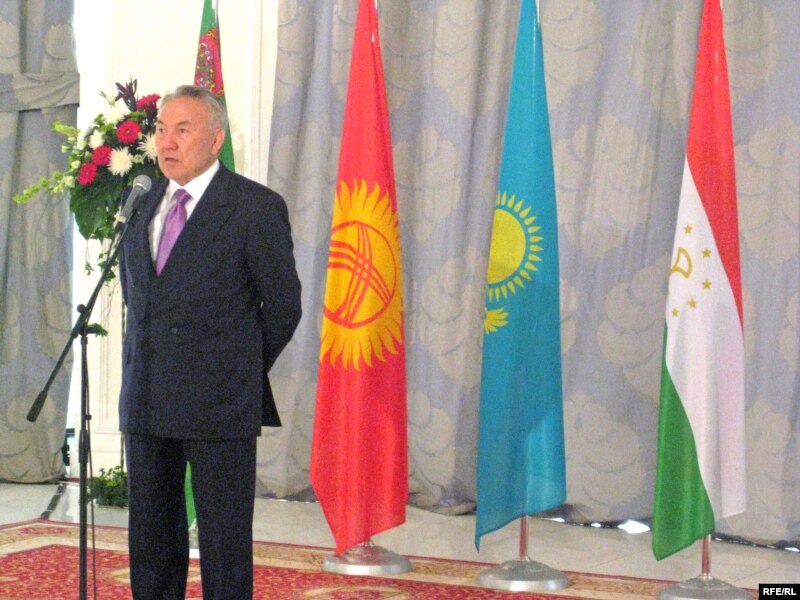
Nazarbaev Circulates His Currency Vision
“Kazakh President Nursultan Nazarbaev has been stumping hard for the “akmetal.”
July 29, 2010
Kazakh President Nursultan Nazarbaev appears keen to introduce a common global currency. One way or another. “I continue to insist that the new global economy requires a new global currency,” Nararbaev said during a recent economic forum in the Kazakh capital, Astana. He also “continued to insist” on the topic during an informal meeting of the OSCE Foreign Ministers in Almaty earlier this month. In his article, “Keys To The Crisis,” published in the Russian newspaper “Rossiiskaya gazeta” in February 2009, Nazarbaev suggested that a common currency could help lead the world out of financial turmoil. Nazarbaev has suggested calling it the “akmetal,” a word coined from the Greek “acme” — meaning “supreme” or “best” — and “capital.” The Kazakh president says that with the akmetal firmly in place, the term “akmetalism” could eventually replace “capitalism” to describe the world’s dominant economic system. In the past, he has suggested the creation of a common currency for the Eurasian Economic Community, a regional treaty comprising six former Soviet countries — Russia, Belarus, and the Central Asian republics sans Turkmenistan. Nazarbaev is by no means the first advocate of such a scheme. In the 1940s, leading British economist John Maynard Keynes suggested the creation of a common currency along with a world central bank and an international clearing union to manage it. He wanted to call the common currency the “bancor.” Keynes’ bancor never materialized, but his idea for world financial institutions eventually led to the creation of the so-called Bretton Woods institutions: the World Bank and the International Monetary Fund. So, despite an apparent lack of supporters for the akmetal, don’t kill Nazarbaev’s idea just yet. Leave it to future economists and akmetalists to decide.”
Prophecy Sign: Revelation 13:16-17 Here Jesus warned us under the Antichrist no one will be able to buy or sell anything unless you worship the Antichrist. Here is one more step leading us in that direction
Why contactless payment paves the way for a cashless society
Stuart Neal, head of UK payment acceptance at Barclaycard speaks about developments in the payments industry.
Whilst we’re all familiar with chip and pin, another payment technology has been growing in popularity. It is estimated that over 9.6 million[1] contactless-capable cards have been issued by card providers in the UK, so around one in six cardholders already have a card that doesn’t require a pin to be entered for transactions under £15, simply a flash of a card on a reader.
A recent report from analysts, Datamonitor, has reignited the debate as to whether widespread use of contactless payment is just around the corner or some way off. Datamonitor has come down firmly on the side of ‘some way off’, arguing that until there is demand from consumers, retailers will not make the investment to go contactless.
Barclaycard and Barclays have taken a lead on contactless because we fundamentally believe that it, and the cashless society it heralds, is the future. Furthermore, contrary to Datamonitor’s report we believe that future is closer than they anticipate.
Forward thinking retailers such as EAT. and Prêt a Manger are already reaping the rewards: contactless credit and debit card terminals eliminate the need for cash for even small transactions, enabling retailers to speed up sales at the tills and to avoid the hassle of handling large quantities of money.
Barclaycard, along with Barclays, have 25,000 contactless terminals live and accepting payment across the country.
Nor are consumers being left behind. The Payments Council recently predicted that cash payments would account for fewer than half of all transactions within just five years, with consumers increasing the amount consumers spend with cards fourfold in the last decade[2].
Indeed, for retailers and consumers alike, cash is increasingly becoming more of a burden than a straightforward form of payment. The cost to retailers of processing it is huge, queues become uncontrollable as customers fumble for change in shops, and having to remember to get cash out from an ATM just becomes another thing to think about in consumers’ busy lives.
In response to the need for an easy and innovative replacement to cash, contactless payment in the UK has taken off in the past three years for low value purchases. Since September 2007, Barclays and Barclaycard have issued over eight million contactless-enabled cards, allowing customers to make transactions quicker and more easily. As a result of the ease of payment, 61% of users find it preferable to using cash.[3]
Some retailers may worry that contactless could cost them more than cash. However, considering the hidden costs borne by retailers in handling, storing and banking cash, contactless could well prove a cheaper option overall. Smaller retailers will receive contactless capability automatically when their card reading hardware is periodically replaced. Large retailers will need upgraded terminals and software, but this can be done during a standard replacement or upgrade cycle, and nearly all EPoS software supports contactless.
Recently, we have seen other card providers begin to join Barclays and Barclaycard in providing a contactless service. In America, Canada and Australia, contactless is already used extensively, boosted by a transaction limit of $50.
Contactless is increasingly being seen as a way to cement relationships with customers and provide ownership of the customer journey – whether that is providing point-to-point in travel or over the course of several days at a festival.
Contactless has become widespread in Europe, with Italy and Turkey in the process of adapting their transport networks to accept contactless payment. In the UK, the system is rapidly growing in popularity with key retailers having announced their commitment to quicker queues and slicker transactions, and with a number of music festivals, such as Wireless, trailing the use of contactless technology.
Contactless speeds up transactions as it does not require a customer to enter a PIN or enter their card into a payment terminal. Once the card has been placed over the contactless terminal, the transaction uses secure technology to automatically add the purchase to the customer’s credit card bill or debit it from their current account.
As with all credit and debit cards, security is of paramount concern and as a result, contactless uses tried and tested, reliable payment technology. In addition, there is a £15 limit on single transactions and a card can only be used on multiple transactions using solely contactless payment a certain number of times before a customer is prompted for their PIN.
In the unlikely event of fraud, contactless debit and credit transactions benefit from the same 100% fraud guarantee as standard transactions.
Whilst the chip is currently inserted into cards, it is intended that by 2012 contactless mobile phones will be widely available allowing consumers to not only make purchases with greater ease but also keep a close eye on what they are spending through their phone.
Barclays and Barclaycard anticipate that in the next two years use of contactless payments systems will become widespread across multiple sectors.
Contactless is growing fast, with many credit and debit card providers issuing contactless-enabled cards as standard when a card comes up for renewal. The reality is that consumers are choosing not to use cash; that soon for more than half of purchases, cards will be used instead.
This provides a golden opportunity for retailers as it allows them to take advantage of innovative technology to provide customers with the smooth service they demand as it reduces costs. With 26,000 live terminals, contactless has grown quickly and the speed of that growth is increasing.
What’s more, contactless is set to play a key role in mobile banking, which, with its customer-centric focus, is the future.
Few technological developments are adopted by consumers as quickly as analysts would like, but contactless does now have momentum. Customers are increasingly aware as a result of successful marketing campaigns and larger retailers are beginning to take the plunge, having realised the hidden cost of spare change.
A lot of things from Bible Prophecy are going to effect our basic needs. The crazy weather events, droughts, intense heat, as well as hyper-inflation will make it very difficult to get enough food to feed our families. I don’t know when it will all begin accelerating, you can already see some of it, food costs are going up but I would suggest investing in food storage for your family. Look at it as an insurance policy, in case we are not raptured before these birth pains reach an unbearable level.
Two great sources to look into stored food for your family are linked below. It really gives you a piece of mind to know that your family will be able to eat for a year or more if we must live through these coming events. It is amazing stuff that can last unopened for 20-30 years so you can truly use it as a purchase and forget it type mindset.
www.foodinsurance.com – I have heard good things about this alternative, must more of a turn-key approach.
Below is pulled from Frank DiMora’s site. Link to his full days Blog here.
————————————————————————————————————
Prophecy Sign: “Then I heard what sounded like a voice among the four living creatures, saying, “A quart of wheat for a day’s wages, and three quarts of barley for a day’s wages, and do not damage the oil and the wine!”
Russian Prime Minister Vladimir Putin walks through a wheat field in Vyselk…
“In connection with the unusually high temperatures and the drought, I consider it right to impose a temporary ban on the export from Russia of grain and other products produced from grain,” Putin told a government meeting.
Russia, currently the world’s number three wheat exporter, earlier this week slashed its grain harvest forecast to 70-75 million tonnes owing to the worst drought for decades.
Last year, Russia exported 21.4 million tonnes of grain and observers had already warned this risks being sharply lower this year owing to the drought.
The prime minister’s spokesman Dmitry Peskov said that the embargo would come into force from August 15 and would remain in place until December 31, the Interfax news agency reported.
“We must not allow an increase in domestic prices and must preserve the headcount of our cattle,” said Putin in comments broadcast on state television. Putin said that grain from the government’s intervention fund would be handed out to the regions most in need without any auction.
“Concerns about Russia — coupled with a drought that has also hit Ukraine and Kazakhstan as well as a low harvest in Canada — have already led to a spike in global wheat prices to two year highs.”
If you doubt Jesus words and His warnings you may want to read a section from this next report entitled: “Commodity prices soar as spectre of food inflation is back”
“Speculation and rumour could be the driving force behind sudden market rise in food prices” “The price of wheat, oil and copper soared this week but the picture looks much less clear this time. Old-fashioned supply and demand is still at work, but there are fears that wild rumours and speculation are driving up prices. Wheat prices, which are up 40% over the last month, reached a two-year high as concerns about a drought in Russia and rotting stocks of grain in India exercised markets in London and Chicago. Claims that a major crop failure in Australia, following an invasion of locusts and a wet summer in Canada, could lead to a worldwide shortage,have pushed up prices in recent weeks to levels not seen since 2008. The rise in futures contract prices traded on the major markets also follows a United Nations report in June that warned food prices could rise as much as 40% over the coming decade, amid growing demand from emerging markets and for biofuel production”
Here is more proof about the rising food costs in a report entitled: “A Global Need for Grain That Farms Can’t Fill”. I quote. “LAWTON, N.D. — Whatever Dennis Miller decides to plant this year on his 2,760-acre farm, the world needs. Wheat prices have doubled in the last six months. Corn is on a tear. Barley, sunflower seeds, canola and soybeans are all up sharply. “For once, there’s great reason to be optimistic,” Mr. Miller said. But the prices that have renewed Mr. Miller’s faith in farming are causing pain far and wide. A tailor in Lagos, Nigeria, named Abel Ojuku said recently that he had been forced to cut back on the bread he and his family love. “If you wanted to buy three loaves, now you buy one,” Mr. Ojuku said.
Frank has listed many of these videos before, you can find them out on You-Tube or in earlier posts on Frank DiMora’s site. I thought I would include it as a sample, since it is relevant to the articles above.
These Video may seem like you are entering fringe territory but a good portion of what he says does come to pass, you just need to take it will a grain of salt.
One of the voices of truth on the economic is Peter Schiff. He is one of the only ones to get it right over the last few years and predicted the last dip. What he is talking about in the video/audio below is how our economy is being run into the ground. This is needed for One World Currency and One World Government to take hold.
"For it is by grace you have been saved, through faith--and this not from yourselves, it is the gift of God--not by works, so that no one can boast. For we are God's workmanship, created in Christ Jesus to do good works, which God prepared in advance for us to do." -- Ephesians 2:8-10



 myBlessedHope
